

Genetics
FTD affects men and women roughly equally, and known risk factors are similar to those seen in other types of dementia. For the majority (about 70–80%) of individuals diagnosed with FTD, there is no clear cause or family history of the condition. In these instances, the disease is described as sporadic.
Around 20–30% of individuals with FTD, however, have a genetic or familial form of the disease, meaning it runs in families and is caused by a change (mutation) in a specific gene. This is more common in some FTD syndromes than others.
In bvFTD, about 30-40% of individuals have a family history of the disease. In roughly half of these people, a mutation is found in one of three known genes: MAPT, GRN, or C9orf72. Much more rarely, a mutation in another gene that can cause bvFTD may be found. These mutations can be passed across generations. In other words, each child will have a 50% risk of inheriting the faulty copy of the gene from their affected parent.
In the language variants of FTD - SD and PNFA - a genetic cause is much less common, occurring in fewer than 5% of cases.
FTD-MND has one of the strongest genetic associations. A C9orf72 mutation is found in a high proportion of familial cases, and may also be present in individuals with no known family history, particularly if both cognitive and motor symptoms are present.
In families where no known mutation has been found, other genetic factors may be involved but are not yet understood.
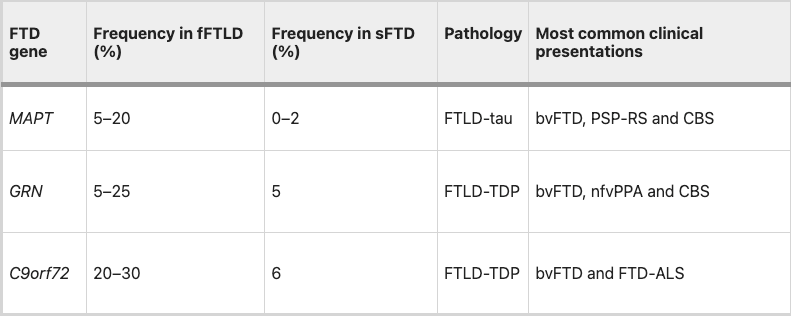
Frequency, pathology and common clinical presentations associated with FTLD are taken from Grossman, M., Seeley, W.W., Boxer, A.L. et al. Frontotemporal lobar degeneration. Nat Rev Dis Primers 9, 40 (2023). https://doi.org/10.1038/s41572-023-00447-0
If you have a family history of FTD or concerns about inherited risk, speak with your treating clinician to learn more about genetic counselling and testing. A list of public genetic services in Australia, organised by state or territory is available on the Centre for Genetics Education website: https://www.genetics.edu.au/SitePages/Genetic-services-listing.aspx
A list of private genetics services is maintained by the Human Genetics Society of Australasia, available on their website:
https://hgsa.org.au/Web/Web/HP-Resources/Clinical-genetics-services-by-state/Clinical-Genetic-Services.aspx